

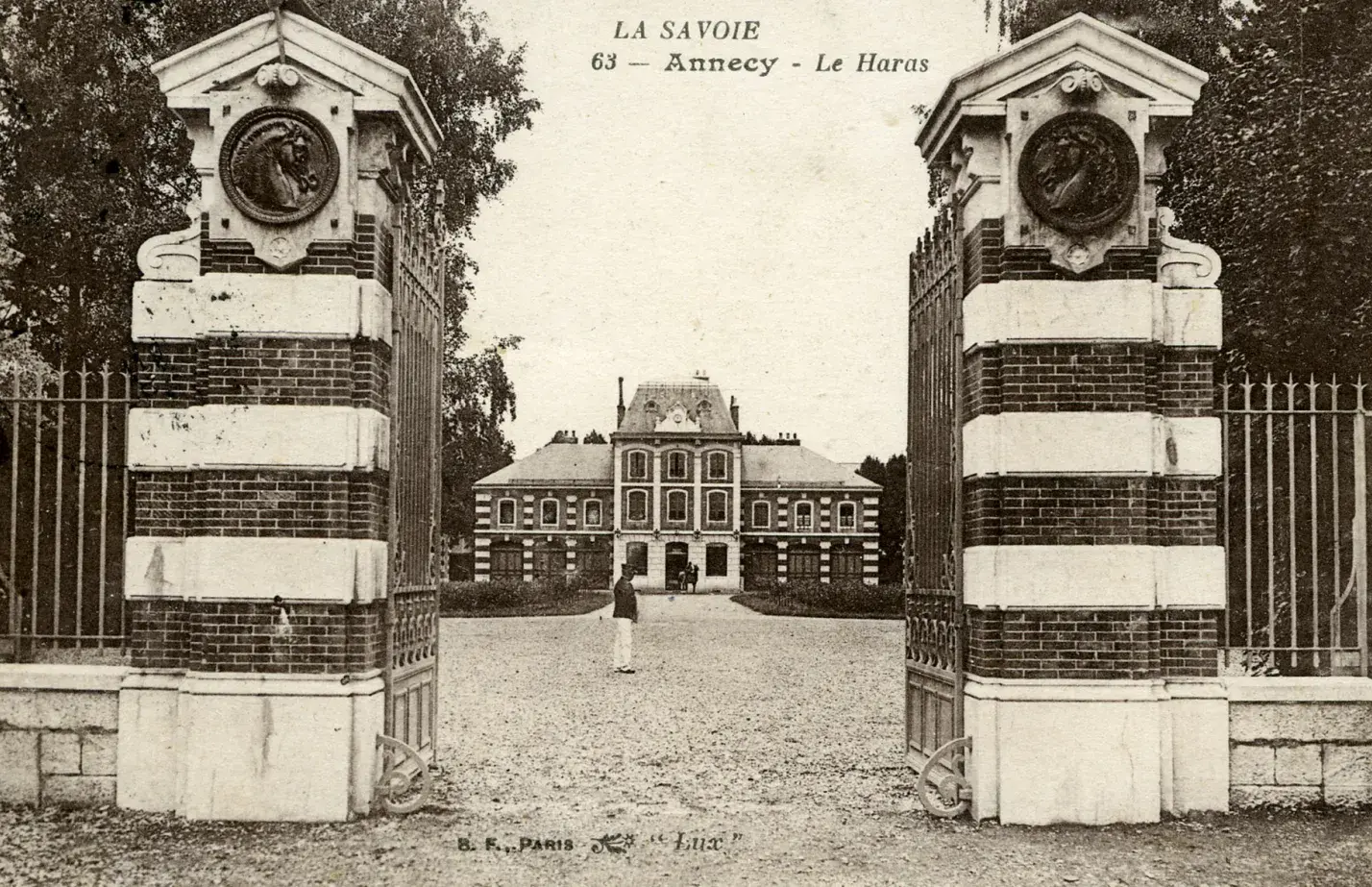
© Archives municipales Annecy/Ed. Bertaud frères/Fonds Robert Langlet
The Annecy Haras is a city oasis set within 2.6 hectares of landscaped gardens. It is currently being extensively renovated to be transformed into a destination for heritage, culture and gourmet food, with stakeholders joining forces to foster a strong community spirit.

Built in the 1880s and listed as a historic monument in 2007, the site was acquired by the City of Annecy in 2013. After 145 years closed to the public, the site was opened to the community, and over the past decade it has hosted temporary cultural spaces and events for the city and its residents.
The horse: the Haras' emblem and protagonist of pre-cinema.
The period when these buildings were erected coincides with another story: cinematography. The link between horses and animation films may not seem obvious at first glance, yet a happy coincidence weaves a narrative that resonates with the Haras d'Annecy.
The horse has always been a source of fascination throughout art history, from the prehistoric horse paintings in the Chauvet-Pont-d’Arc Cave to Zeus, the equestrian symbol of the Paris 2024 Olympic Games opening ceremony. In the late 19th century, a controversy arose over how a horse gallops: does it lift all four legs off the ground at the same time? It is impossible to tell with the naked eye, and physiologists disagree. In 1878, photographer Eadweard Muybridge set up 24 cameras along a whitewashed equestrian track to capture the stallion's movement frame by frame and analyse its gait. Based on Étienne-Jules Marey's work on motion analysis, this experiment is part of the fascinating history of pre-cinema and its rapid development during the 19th century, leading up to the invention of the Cinematograph by Louis and Auguste Lumière in 1895.
Pursuing his research, Muybridge invented the zoopraxiscope, an optical toy based on Joseph Plateau's phenakistoscope, which reconstructs movement through viewing the phases in rapid succession. Muybridge made transparent glass discs on which he painted, or stuck images taken from his photographs, then projected them onto a large screen using a magic lantern. In 1881, he projected a disc showing a horse's skeleton.
Since then, the horse has symbolized the moving image: the plates from Animal Locomotion (Muybridge's series of photographic works) are preserved at the Academy Museum of Motion Pictures in Los Angeles. As such, installing the Cité internationale du cinéma d'animation at the Haras d'Annecy holds symbolic significance. The horse joins the rabbit as the new mascot of the world capital of animation film!
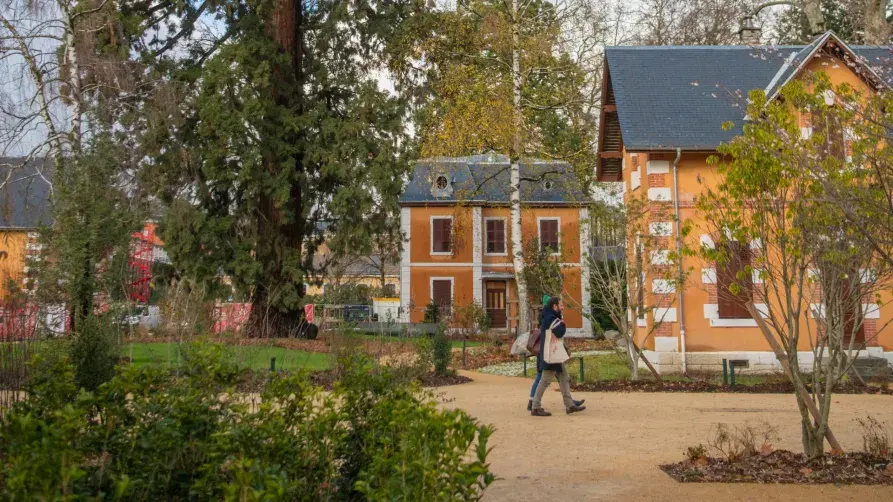
Photo : VILLE-ANNECY/Q. Trillot
The landscaped gardens
Nestled in central Annecy, the public gardens provide an ideal setting for visitors to unwind, recharge, and discover the area's unique features. Landscape architect Philippe Deliau explains that "this project draws inspiration from both the iconic romantic gardens of the late 19th century and the practices and requirements of contemporary public spaces. The grounds have been renovated to recreate shaded glades, spots for reading and relaxing, where artistic creations are subtly incorporated under the trees."
The Cité's location right in the heart of this park lends itself perfectly to a seasonal rhythm: spring, summer, autumn and winter will punctuate life in the park and the activities offered at the Cité throughout the year.
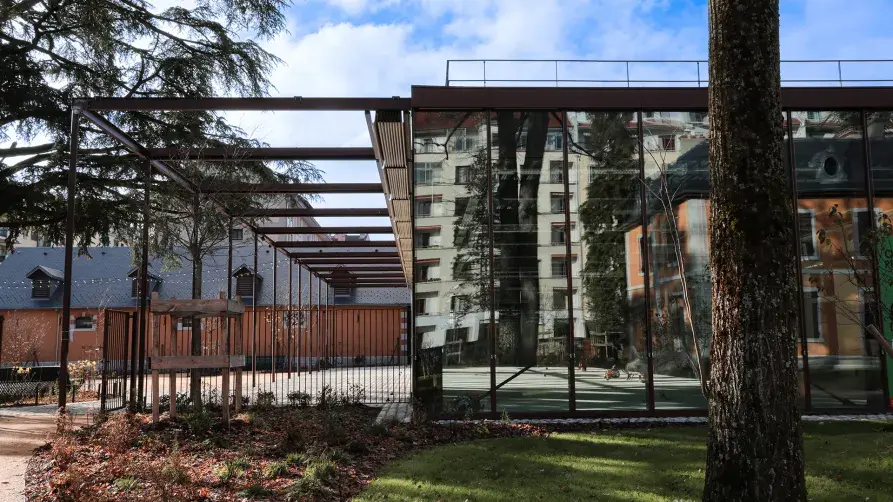
Photo : CITÉ ANIMATION/A. Trichet-Laurier
The Halle du Haras
The 1,300 m² Halle du Haras managed by Biltoki, hosts around twenty local and regional artisan producers (greengrocers, bakers, cheesemongers, butchers, fishmongers, etc.), promoting high-quality and locally sourced products. The food tasting points on the stalls are complemented by a shared dining area and a central café-bar.
The friendly atmosphere throughout the Haras site is a valuable asset for the Cité. Who knows, a festival linking gastronomy and animation film might even be launched in the future!
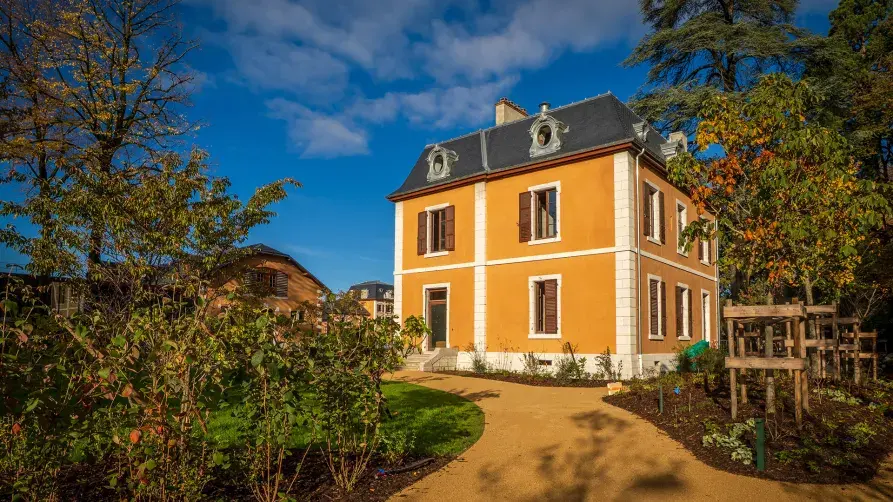
Photo : VILLE ANNECY/G. Piel
The Villa du Haras
A venue where people can meet and exchange ideas, promoting social ties and supporting community involvement.